Skip to content

Clearing offers from 64 UCAS tariff points. Subject-specific requirements still apply. See the entry requirements section for details.

Design spaces. Shape cities. Build a career with purpose.

The historic city of Lincoln has roots in Roman Britain, providing an inspiring context in which to explore architecture and learn about heritage and archaeology in relation to contemporary architectural design.

The BArch (Hons) Architecture degree aims to prepare students for a career in the exciting field of architectural practice, placing a strong emphasis on design and creativity. The University is part of the well-established RIBA Mentoring Scheme, giving third-year students the opportunity to gain real-world experience with professional architects.

This course is validated by the Royal Institute of British Architects (RIBA) as providing exemption from Part 1 examinations.

The course forms the first stage of a three-part programme of education and training for aspiring architects. The University of Lincoln also runs RIBA / ARB Parts 2 and 3 programmes, and all three parts are required to register as an architect in the UK.

There is a strong emphasis on design and creativity and the course aims to prepare students for a global career in the exciting field of architectural practice.

We are designers working to create imaginative and practical building designs. The Lincoln School of Architecture and the Built Environment is a cooperative, multidisciplinary environment for sharing ideas, which aims to support students in discovering their own design approach.

The historic city of Lincoln has roots in Roman Britain, providing an inspiring context in which to explore architecture and learn about heritage and archaeology in relation to contemporary architectural design.

The BArch (Hons) Architecture degree aims to prepare students for a career in the exciting field of architectural practice, placing a strong emphasis on design and creativity. The University is part of the well-established RIBA Mentoring Scheme, giving third-year students the opportunity to gain real-world experience with professional architects.

This course is validated by the Royal Institute of British Architects (RIBA) as providing exemption from Part 1 examinations.

The course forms the first stage of a three-part programme of education and training for aspiring architects. The University of Lincoln also runs RIBA / ARB Parts 2 and 3 programmes, and all three parts are required to register as an architect in the UK.

There is a strong emphasis on design and creativity and the course aims to prepare students for a global career in the exciting field of architectural practice.

We are designers working to create imaginative and practical building designs. The Lincoln School of Architecture and the Built Environment is a cooperative, multidisciplinary environment for sharing ideas, which aims to support students in discovering their own design approach.

Illustration of a head being split in half with colours escaping.

Don't meet the full entry requirements?

Arts Foundation Year

The Arts Foundation Year at Lincoln is the first year of a four-year degree programme, offering students the chance to explore a range of creative subjects including Animation, Architecture, Fine Art, Graphic Design, Illustration, Photography, and Product Design before progressing onto a specialist degree.

Why study Architecture at Lincoln?

  • Design-led, career-focused learning
    Build a portfolio that employers and practices actually want to see.

  • Accredited pathway to becoming an architect
    This degree is RIBA validated and designed to support your journey toward professional qualification.

  • Studio-based teaching from day one
    Learn by doing, not just listening.

  • Dedicated design studios
    Your own creative space to develop ideas and collaborate.

  • Strong focus on sustainability and real-world design
    Tackle the challenges shaping modern cities and environments.

  • Industry-informed projects
    Work on briefs that reflect real architectural practice.

  • Supportive, collaborative studio culture
    Learn alongside peers, guided by practising architects and academics.

  • A city that inspires design thinking
    Lincoln blends historic architecture with modern development — a living case study.

What you'll learn

This course is structured to help you think and work like an architect — combining creativity, technical knowledge, and problem-solving.

You’ll learn how to:

  • Design buildings and spaces that respond to real human needs
  • Develop creative concepts into detailed, buildable designs
  • Use industry-standard tools such as CAD and digital modelling software
  • Understand construction and materials, so your ideas can become reality
  • Explore sustainability, including environmental design and responsible building
  • Communicate your ideas visually and verbally, a key skill in architecture careers

By the end of the course, you’ll graduate with a professional portfolio showcasing your design work — essential for job applications or further study.

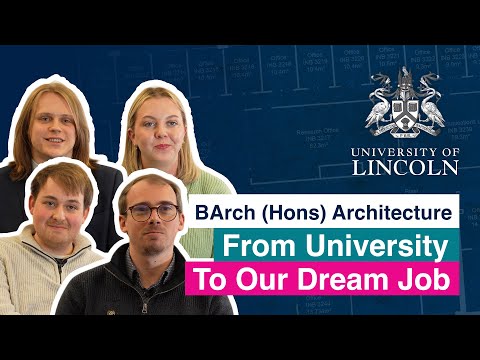
Meet Our Graduates!

From the University of Lincoln to jobs in their field, here's how our Architecture graduates valued their time at Lincoln. Find out what our graduates enjoyed, what they miss about University and how their course prepared them for their careers.

YouTube video for

Modules

Module Overview

The Design 1 stream establishes the creative foundations upon which all subsequent architectural and interior design learning is built. Through a series of design studios and workshops, students immerse themselves in “thinking through drawing and making,” exploring and producing two- and three-dimensional form, space and composition. Learners develop an intuitive understanding of space through the understanding of scale, proportion and human experience.

Emphasising discovery-based inquiry, the module teaches design as a rigorous research process situated in its built-environment context. Students learn to analyse briefs, sites and precedents; to apply design theory, methods and environmental strategies; and to experiment with spatial composition.

Module Overview

The Interpret 1 stream grounds your creative explorations in research and critical thinking. Beginning with a broad historical survey, you will examine pivotal architectural and design movements, then gradually narrow focus to regional case studies and seminal precedents. Seminars will introduce you to methods of academic inquiry—source analysis, comparative study and thematic critique. Delivered alongside the Design and Realise streams, Interpret ensures your first-year projects are informed by a deep understanding of the forces that shape our built environment.

Module Overview

This module introduces students to the professional contexts, responsibilities and opportunities within the built environment. Through real-world case studies, workshops and collaborative projects, you will explore the roles and interrelationships of clients, architects, engineers, contractors and consultants, and map out the routes to professional qualification and diverse career pathways. Emphasis is placed on the impact of professional practice on sustainability, health and wellbeing, and on designing inclusive environments that support social and economic equity. Ethical considerations, emerging industry trends and entrepreneurial mindsets are woven throughout, preparing you to engage critically and creatively in multidisciplinary teams from day one.

Module Overview

The Realise 1 stream invites you to test and refine your design concepts through visual and material enquiry. You will begin with analogue sketch-based studies then translate these into small-scale physical models and simple digital prototypes. Anchored by enquiry-based learning and delivered in parallel with the Design stream, Realise ensures that conceptual visions are immediately subject to hands-on validation, fostering a rich feedback loop between idea and execution.

Module Overview

This studio module develops design capabilities at urban and building scale through projects addressing adaptive reuse, heritage contexts, and urban design. Students explore architectural responses to existing buildings and urban fabric, considering cultural, social, environmental, and economic factors in design development. The module emphasises contextual analysis, sustainable reuse of existing building stock, and urban design principles.

Module Overview

The module focuses on knowledge and understanding of architecture in place. It explores broad theoretical paradigms that influence architectural experience and architectural intervention. The study of existing structures to understand their cultural, aesthetic and material significance in transformed contexts / socio-economic conditions for a core focus of the module.

Module Overview

The module focuses on knowledge and understanding of architecture in place. It explores broad theoretical paradigms that influence architectural experience and architectural intervention. The study of existing structures to understand their cultural, aesthetic and material significance in transformed contexts / socio-economic conditions for a core focus of the module.

Module Overview

This module introduces students to the organisation and leadership of professional practice in the built environment. It examines the factors that shape practice management and the role of information management systems, while supporting students in developing reflective portfolios and professional CVs to enhance their professional and career development.

Module Overview

The module integrates learning from the interpreting module to propose technological solutions to the architectural design project. Adaptive reuse and architectural intervention / constructions that relate to existing buildings of historical / social / cultural / economic significance forms a key area of learning.

Module Overview

The Industry Placement Year is an exciting opportunity for students to take a year out of formal study to gain real-world experience in the creative industries. Whether you’re looking to build industry connections, develop professional skills, or explore career options, this year will give you a full-time, hands-on experience within a creative organisation.

This year is a collaborative experience between you, your employer, and the University—ensuring that you get the most out of your time in a professional setting.

Module Overview

This module provides an opportunity for students in the Lincoln School of Design & Architecture to spend a semester in Year 2 studying at one of the University’s partner institutions. This opportunity has both academic and personal development dimensions.

In academic terms, during the semester abroad students undertake models that are equivalent to 60 credit module and content at one of the UoL partner institution in semester B.

Participation in study-abroad also offers unique opportunities for personal student development in the wider sense. Although students will be supported through the application process by the Module Co-ordinator and colleagues at the partner institution, much of the responsibility for organising the time abroad rests with the student. Study abroad offers the opportunity for students to develop graduate attributes, a global mindset and transferrable skills as exercise resilience, flexibity and open mindedness when adapting to and working effectively within a different academic culture and environment.

Students must submit an application to the School discuss why they wish to participate in a study period abroad.

Module Overview

This module is optional for undergraduate students within the College of Social Sciences and Humanities. Study Abroad enables you to study at one of the University’s approved partner institutions.

During the time spent abroad, you can share classes with local students and study modules at the partner institution which have been approved in advance by the University. As many partner institutions support internships, you may choose to combine study with work and/or a period of volunteering.

Module Overview

A research-led, enquiry-based, mode defines the approach of this design module. Students have the opportunity to identify their own design problem, engage with design research, and develop responsive solutions to their design contexts. Students will be guided in developing techniques of design inquiry and design development process through seminars and studio sessions. There is a significant component of independent study required for this module.

Module Overview

This research-based module immerses students into a deeper exploration of an architectural problem in an urban context. Theoretical / conceptual frameworks are used to analyse sources and formulate propositions to answer research questions. The module develops a critical architectural skill, namely, translating theoretical and conceptual positions into meaningful, justifiable, responsive architecture in place and time.

Module Overview

This module examines the key factors influencing project delivery within the built environment, with a focus on balancing cost, time, and quality throughout the design and construction process. Students will analyse the regulatory and business environments that shape project outcomes and explore a range of procurement routes, contractual and tendering arrangements, and contractor selection methods for different project types. The module develops an understanding of how strategic decisions made during project planning and procurement impact successful project delivery.

Module Overview

This module develops knowledge of alternative technologies and materials that complement the development of an architectural concept into a resolved architectural project. Students will develop pragmatic skills in the making of architecture that sustainably utilises technology and materials while complying with the standards and regulations governing building.


† Some courses may offer optional modules. The availability of optional modules may vary from year to year and will be subject to minimum student numbers being achieved. This means that the availability of specific optional modules cannot be guaranteed. Optional module selection may also be affected by staff availability.

Modules

Module Overview

The Design 1 stream establishes the creative foundations upon which all subsequent architectural and interior design learning is built. Through a series of design studios and workshops, students immerse themselves in “thinking through drawing and making,” exploring and producing two- and three-dimensional form, space and composition. Learners develop an intuitive understanding of space through the understanding of scale, proportion and human experience.

Emphasising discovery-based inquiry, the module teaches design as a rigorous research process situated in its built-environment context. Students learn to analyse briefs, sites and precedents; to apply design theory, methods and environmental strategies; and to experiment with spatial composition.

Module Overview

The Interpret 1 stream grounds your creative explorations in research and critical thinking. Beginning with a broad historical survey, you will examine pivotal architectural and design movements, then gradually narrow focus to regional case studies and seminal precedents. Seminars will introduce you to methods of academic inquiry—source analysis, comparative study and thematic critique. Delivered alongside the Design and Realise streams, Interpret ensures your first-year projects are informed by a deep understanding of the forces that shape our built environment.

Module Overview

This module introduces students to the professional contexts, responsibilities and opportunities within the built environment. Through real-world case studies, workshops and collaborative projects, you will explore the roles and interrelationships of clients, architects, engineers, contractors and consultants, and map out the routes to professional qualification and diverse career pathways. Emphasis is placed on the impact of professional practice on sustainability, health and wellbeing, and on designing inclusive environments that support social and economic equity. Ethical considerations, emerging industry trends and entrepreneurial mindsets are woven throughout, preparing you to engage critically and creatively in multidisciplinary teams from day one.

Module Overview

The Realise 1 stream invites you to test and refine your design concepts through visual and material enquiry. You will begin with analogue sketch-based studies then translate these into small-scale physical models and simple digital prototypes. Anchored by enquiry-based learning and delivered in parallel with the Design stream, Realise ensures that conceptual visions are immediately subject to hands-on validation, fostering a rich feedback loop between idea and execution.

Module Overview

This studio module develops design capabilities at urban and building scale through projects addressing adaptive reuse, heritage contexts, and urban design. Students explore architectural responses to existing buildings and urban fabric, considering cultural, social, environmental, and economic factors in design development. The module emphasises contextual analysis, sustainable reuse of existing building stock, and urban design principles.

Module Overview

The module focuses on knowledge and understanding of architecture in place. It explores broad theoretical paradigms that influence architectural experience and architectural intervention. The study of existing structures to understand their cultural, aesthetic and material significance in transformed contexts / socio-economic conditions for a core focus of the module.

Module Overview

The module focuses on knowledge and understanding of architecture in place. It explores broad theoretical paradigms that influence architectural experience and architectural intervention. The study of existing structures to understand their cultural, aesthetic and material significance in transformed contexts / socio-economic conditions for a core focus of the module.

Module Overview

This module introduces students to the organisation and leadership of professional practice in the built environment. It examines the factors that shape practice management and the role of information management systems, while supporting students in developing reflective portfolios and professional CVs to enhance their professional and career development.

Module Overview

The module integrates learning from the interpreting module to propose technological solutions to the architectural design project. Adaptive reuse and architectural intervention / constructions that relate to existing buildings of historical / social / cultural / economic significance forms a key area of learning.

Module Overview

The Industry Placement Year is an exciting opportunity for students to take a year out of formal study to gain real-world experience in the creative industries. Whether you’re looking to build industry connections, develop professional skills, or explore career options, this year will give you a full-time, hands-on experience within a creative organisation.

This year is a collaborative experience between you, your employer, and the University—ensuring that you get the most out of your time in a professional setting.

Module Overview

This module provides an opportunity for students in the Lincoln School of Design & Architecture to spend a semester in Year 2 studying at one of the University’s partner institutions. This opportunity has both academic and personal development dimensions.

In academic terms, during the semester abroad students undertake models that are equivalent to 60 credit module and content at one of the UoL partner institution in semester B.

Participation in study-abroad also offers unique opportunities for personal student development in the wider sense. Although students will be supported through the application process by the Module Co-ordinator and colleagues at the partner institution, much of the responsibility for organising the time abroad rests with the student. Study abroad offers the opportunity for students to develop graduate attributes, a global mindset and transferrable skills as exercise resilience, flexibity and open mindedness when adapting to and working effectively within a different academic culture and environment.

Students must submit an application to the School discuss why they wish to participate in a study period abroad.

Module Overview

This module is optional for undergraduate students within the College of Social Sciences and Humanities. Study Abroad enables you to study at one of the University’s approved partner institutions.

During the time spent abroad, you can share classes with local students and study modules at the partner institution which have been approved in advance by the University. As many partner institutions support internships, you may choose to combine study with work and/or a period of volunteering.

Module Overview

A research-led, enquiry-based, mode defines the approach of this design module. Students have the opportunity to identify their own design problem, engage with design research, and develop responsive solutions to their design contexts. Students will be guided in developing techniques of design inquiry and design development process through seminars and studio sessions. There is a significant component of independent study required for this module.

Module Overview

This research-based module immerses students into a deeper exploration of an architectural problem in an urban context. Theoretical / conceptual frameworks are used to analyse sources and formulate propositions to answer research questions. The module develops a critical architectural skill, namely, translating theoretical and conceptual positions into meaningful, justifiable, responsive architecture in place and time.

Module Overview

This module examines the key factors influencing project delivery within the built environment, with a focus on balancing cost, time, and quality throughout the design and construction process. Students will analyse the regulatory and business environments that shape project outcomes and explore a range of procurement routes, contractual and tendering arrangements, and contractor selection methods for different project types. The module develops an understanding of how strategic decisions made during project planning and procurement impact successful project delivery.

Module Overview

This module develops knowledge of alternative technologies and materials that complement the development of an architectural concept into a resolved architectural project. Students will develop pragmatic skills in the making of architecture that sustainably utilises technology and materials while complying with the standards and regulations governing building.


† Some courses may offer optional modules. The availability of optional modules may vary from year to year and will be subject to minimum student numbers being achieved. This means that the availability of specific optional modules cannot be guaranteed. Optional module selection may also be affected by staff availability.

Support and student experience

Starting university, and a demanding creative course, can feel like a big step. You won’t do it alone.

Academic support

  • Regular feedback on your design work
  • One-to-one guidance from tutors
  • Structured studio sessions to build confidence

Personal support

  • Wellbeing and mental health services
  • Academic skills support (writing, research, time management)
  • Career guidance from early in your degree

Studio culture

Architecture is collaborative, and so is your experience here.

  • Work alongside your peers in shared studio spaces
  • Learn how to give and receive constructive feedback
  • Build friendships and professional networks that last beyond graduation

Accreditation

This course is validated by the Royal Institute of British Architects (RIBA) as providing exemption from Part 1 examinations, which are required to register as an architect in the UK.

The RIBA logo

International Study and Placements

International Study

Study overseas at a partner university and experience a new culture.

  • Build confidence, independence, and intercultural experience
  • You’ll pay the relevant study abroad fee to the University of Lincoln, with no tuition fees paid to the host university
  • You’ll need to cover travel and living costs
  • Funding support may be available


Placements

Gain hands-on experience in a real workplace and apply your learned skills in a professional setting.

  • Develop practical skills and professional confidence
  • Build your CV before you graduate
  • Explore career options in a real workplace
  • Pay a placement year fee
  • You’ll need to cover travel and living costs

My time at Lincoln has enhanced the meaning of architecture, allowing me to understand how it impacts people and place. The teaching has helped me to analyse opportunities and constraints in a much more rigorous way. The collaboration with my tutors gave me the support to allow me to succeed.

Careers and future opportunities

A degree in Architecture opens the door to a wide range of creative and technical careers.

What can you do with this degree?

Graduates commonly move into roles such as:

  • Architectural Assistant
  • Junior Architectural Designer
  • Urban Designer
  • Interior Architect
  • 3D Visualiser / Architectural Visualisation Specialist

Where could you work?

  • Architectural practices
  • Design consultancies
  • Property and construction companies
  • Local authorities and planning organisations
  • Creative industries and design studios

Pathway to becoming an architect

This course forms the first step toward qualifying as a registered architect in the UK. Many students go on to:

  1. Complete a year in industry (placement)
  2. Study a master’s degree
  3. Finish professional training

Reassurance for students

  • You graduate with real, employable skills and a portfolio
  • You’ll understand how the industry works, not just theory
  • You’ll be prepared for further study or immediate entry-level roles

Entry Requirements 2026-27

United Kingdom

104 to 112 UCAS Tariff points.

This must be achieved from a minimum of 2 A Levels or equivalent Level 3 qualifications. For example:

A Level: CCC to BBC

BTEC Extended Diploma: Distinction, Merit, Merit or equivalent.

T Level: Merit

Access to Higher Education Diploma: 45 Level 3 credits with a minimum of 112 UCAS Tariff points.

International Baccalaureate: 29 points overall

A combination of qualifications which may include A Levels, BTEC, EPQ, etc.

Applicants will also need at least three GCSEs at grade 4 (C) or above, which must include English and Maths. Equivalent Level 2 qualifications may be considered.

The University accepts a wide range of qualifications as the basis for entry. We will also consider applicants with extensive and relevant work experience and will give special individual consideration to those who do not meet the standard entry qualifications.

International

Non UK Qualifications:

If you have studied outside of the UK, and are unsure whether your qualification meets the above requirements, please visit our country pageshttps://www.lincoln.ac.uk/studywithus/internationalstudents/entryrequirementsandyourcountry/ for information on equivalent qualifications.

EU and Overseas students will be required to demonstrate English language proficiency equivalent to IELTS 6.0 overall, with a minimum of 5.5 in each element. For information regarding other English language qualifications we accept, please visit the English Requirements pagehttps://www.lincoln.ac.uk/studywithus/internationalstudents/englishlanguagerequirementsandsupport/englishlanguagerequirements/

If you do not meet the above IELTS requirements, you may be able to take part in one of our Pre-sessional English and Academic Study Skills courses.

For applicants who do not meet our standard entry requirements, our Arts Foundation Year can provide an alternative route of entry onto our full degree programmes:
https://www.lincoln.ac.uk/course/afyafyub/

If you would like further information about entry requirements, or would like to discuss whether the qualifications you are currently studying are acceptable, please contact the Admissions team on 01522 886097, or email admissions@lincoln.ac.uk

Contextual Offers

At Lincoln, we recognise that not everybody has had the same advice and support to help them get to higher education. Contextual offers are one of the ways we remove the barriers to higher education, ensuring that we have fair access for all students regardless of background and personal experiences. For more information, including eligibility criteria, visit our Offer Guide pages. If you are applying to a course that has any subject specific requirements, these will still need to be achieved as part of the standard entry criteria.

Entry Requirements 2027-28

United Kingdom

104 to 112 UCAS Tariff points from a minimum of 2 A Levels or equivalent Level 3 qualifications.

If you are eligible for a contextual offer, a one grade or 8 UCAS Tariff point reduction to the standard entry requirements will be applied.

A Level: BBC

BTEC Extended Diploma: DMM

T Level: Merit

Access to Higher Education Diploma: 45 Level 3 credits with a minimum of 112 UCAS Tariff points.

International Baccalaureate: 29 points overall

GCSE's: Minimum of three at grade 4 or above, which must include English and Maths . Equivalent Level 2 qualifications may be considered.


The University accepts a wide range of qualifications as the basis for entry and do accept a combination of qualifications which may include A Levels, BTECs, Extended Project Qualification (EPQ).

We will also consider applicants with extensive and relevant work experience and will give special individual consideration to those who do not meet the standard entry qualifications.


Additional requirements:

- Applicants will be asked to produce a digital portfolio of work.

International

Non UK Qualifications:

If you have studied outside of the UK, and are unsure whether your qualification meets the above requirements, please visit our country pageshttps://www.lincoln.ac.uk/studywithus/internationalstudents/entryrequirementsandyourcountry/ for information on equivalent qualifications.

EU and Overseas students will be required to demonstrate English language proficiency equivalent to IELTS 6.0 overall, with a minimum of 5.5 in each element. For information regarding other English language qualifications we accept, please visit the English Requirements pagehttps://www.lincoln.ac.uk/studywithus/internationalstudents/englishlanguagerequirementsandsupport/englishlanguagerequirements/

If you do not meet the above IELTS requirements, you may be able to take part in one of our Pre-sessional English and Academic Study Skills courses.

For applicants who do not meet our standard entry requirements, our Arts Foundation Year can provide an alternative route of entry onto our full degree programmes:
https://www.lincoln.ac.uk/course/afyafyub/

If you would like further information about entry requirements, or would like to discuss whether the qualifications you are currently studying are acceptable, please contact the Admissions team on 01522 886097, or email admissions@lincoln.ac.uk

Contextual Offers

At Lincoln, we recognise that not everybody has had the same advice and support to help them get to higher education. Contextual offers are one of the ways we remove the barriers to higher education, ensuring that we have fair access for all students regardless of background and personal experiences. For more information, including eligibility criteria, visit our Offer Guide pages. If you are applying to a course that has any subject specific requirements, these will still need to be achieved as part of the standard entry criteria.

Is this course right for you?

This course could be a great fit if you:

  • Enjoy art, design, or creative problem-solving
  • Are curious about buildings, cities, and how people use space
  • Want a career that combines creativity with real-world impact
  • Like the idea of working on projects rather than just exams

You don’t need to have everything figured out — but you should be ready to explore, experiment, and develop your ideas.

Fees and Funding

University Study is a major investment, so it’s important to understand the costs and support available. A full breakdown of the fees associated with this programme can be found below. Eligible students may be able to access scholarships and bursaries to help with study costs.

Course Fees

Course-Specific Additional Costs

Standard workshop induction costs are usually covered by the University, as are some initial printing and material costs. However, depending on the media/materials chosen by the student, there may be additional material and printing costs incurred.

Mandatory field trip costs are covered by the University, but optional study visits which may include international trips or a student exchange programme, are at the student’s own expense.

Fees and Funding

University Study is a major investment, so it’s important to understand the costs and support available. A full breakdown of the fees associated with this programme can be found below. Eligible students may be able to access scholarships and bursaries to help with study costs.

Course Fees

Course-Specific Additional Costs

Standard workshop induction costs are usually covered by the University, as are some initial printing and material costs. However, depending on the media/materials chosen by the student, there may be additional material and printing costs incurred.

Mandatory field trip costs are covered by the University, but optional study visits which may include international trips or a student exchange programme, are at the student’s own expense.

What You Need to Know

We want you to have all the information you need to make an informed decision on where and what you want to study. In addition to the information provided on this course page, our What You Need to Know page offers explanations on key topics including programme validation/revalidation, additional costs, and contact hours.

What You Need to Know

We want you to have all the information you need to make an informed decision on where and what you want to study. In addition to the information provided on this course page, our What You Need to Know page offers explanations on key topics including programme validation/revalidation, additional costs, and contact hours.

The University intends to provide its courses as outlined in these pages, although the University may make changes in accordance with the Student Admissions Terms and Conditions.