Skip to content

Clearing offers from 72 UCAS tariff points. Subject-specific requirements still apply. See the entry requirements section for details.

Train to become a registered nurse. Graduate ready for the realities of modern healthcare.

Adult nursing is about more than clinical skills. It's about making decisions under pressure, supporting people at their most vulnerable, and becoming someone others rely on.

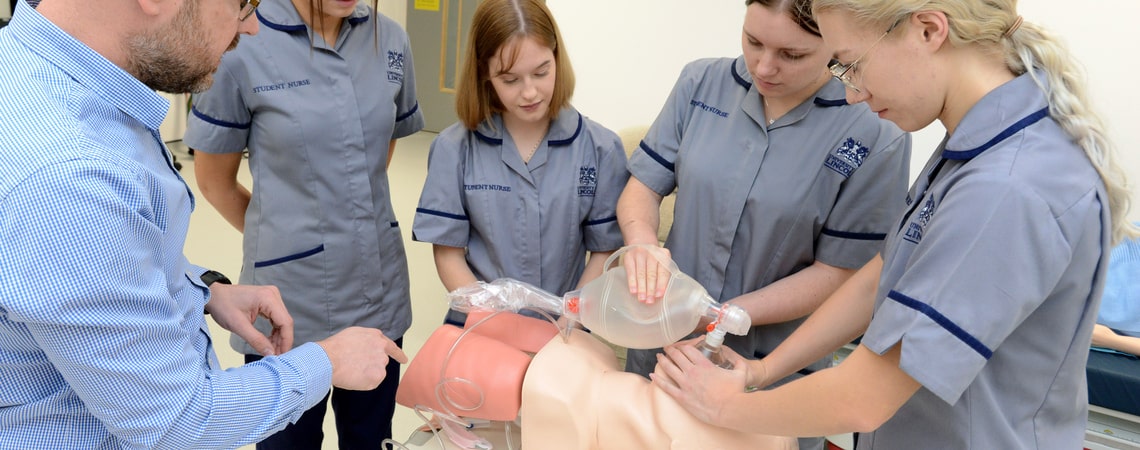
At Lincoln, you'll train in realistic clinical environments, learn from experienced practitioners, and spend a significant part of your degree on placement within NHS settings. By the time you graduate, you'll be ready to register with the Nursing and Midwifery Council (NMC) and step straight into practice.

This course is designed to take you from interested to capable, and from capable to confident.

Adult nursing is about more than clinical skills. It's about making decisions under pressure, supporting people at their most vulnerable, and becoming someone others rely on.

At Lincoln, you'll train in realistic clinical environments, learn from experienced practitioners, and spend a significant part of your degree on placement within NHS settings. By the time you graduate, you'll be ready to register with the Nursing and Midwifery Council (NMC) and step straight into practice.

This course is designed to take you from interested to capable, and from capable to confident.

Accredited Programme

This course is accredited by the Nursing and Midwifery Council (NMC), and enables you to register as a qualified nurse upon graduation. You'll be required to complete competencies for nursing in practice as part of the NMC Future Nursing: Standards framework for Nursing and Midwifery (2018).

Accreditation logo for NMC

Why study Adult Nursing at Lincoln?

Graduate ready for registration This course is approved by the Nursing and Midwifery Council (NMC), meaning you can apply to join the professional register when you graduate. 

Real clinical experience from early on You’ll spend around half your time on placement in NHS and healthcare settings, building practical experience alongside your studies. 

Learn in simulation environments that reflect real care settings Practise safely before stepping into placement, using specialist clinical suites designed to mirror hospital and community care. 

Develop decision-making, not just technical skills Nursing is about judgement, communication, and care under pressure. You’ll build all three. 

Strong employer links Close relationships with regional healthcare providers help ensure your training reflects real workforce needs. 

A supportive learning environment Smaller cohort feel compared to some larger institutions, with access to academic staff who know you. 

City-sized, student-focused experience Lincoln offers a balance of opportunity and manageability. You’re not lost in a crowd, but you still get a full university experience. 

What you'll learn

This course builds your knowledge step by step, linking theory directly to practice.

You’ll learn how to:

  • Assess patients and make informed clinical decisions
  • Deliver safe, evidence-based care across a range of conditions
  • Support people with long-term, acute, and complex health needs
  • Communicate effectively with patients, families, and multidisciplinary teams
  • Respond to changing situations in fast-paced healthcare environments

Alongside this knowledge, you’ll also explore areas like:

  • Anatomy and physiology
  • Pharmacology and safe medication practice
  • Public health and prevention
  • Ethics, professionalism, and patient-centred care

Everything is designed to prepare you for what actually happens on shift.

Modules

Module Overview

The aim of this module is to widen students' understanding of health, well-being and communities. Students will gain knowledge of how our health is impacted – learning what determines our health and where there are clearly identified health inequalities. Students will be supported to interrogate public health data, read seminal public health reports and explore international, national, and local health priorities. They will start to gain skills and knowledge in how nurses can promote health, undertake early intervention to prevent ill health and protect patients and service users.

Module Overview

In this module, you can develop an understanding of human anatomy and physiology across the lifespan and are able to explore health and human development in terms of physiological processes, to consider health, illness, and disease. You will also have the opportunity to develop your fundamental nursing care skills, in preparation for your first practice placement.

Module Overview

The aim of this module is to introduce you to the role of the nurse within contemporary healthcare and within your chosen field of nursing. You will develop knowledge and understanding of key concepts within nursing, including moral, legal and ethical aspects. In addition, you will be supported in the development of appropriate academic and study skills. You will also engage in activities designed to allow you to achieve personal and professional growth, including self-awareness, resilience and team-working.

Module Overview

The aim of this module is to provide you with the opportunity to undertake practice learning in a safe, supported, and appropriate environment in accordance with the Nursing and Midwifery Council (2018) standards.

During this module, you will have practice learning opportunities that allow you to ‘meet the professional values, communication and relationship management skills and nursing skills to meet specific aspects of the standards of proficiency for registered nurses’ (Nursing and Midwifery Council, 2018, p.13).

You can attend placements where you will be a supernumerary member of the team. You will be supported by registered professionals who will act as practice supervisors, by non-registered colleagues, and the multi-disciplinary team. A Registered Nurse will be assigned to work with you as your Practice Assessor and will work with you to ensure completion of the practice assessment document.

You will be supported by the University team and an allocated Academic Assessor to develop your professional skills and attributes.

Your allocated practice placements during Part 1 will allow you to observe, participate and assist in the provision of evidence-based care. By the end of your Part 1 placements, you should demonstrate a minimum level of skills, knowledge, and behaviours, described as: Guided participation in care and performing with increasing confidence and competence.

Module Overview

The aim of this module is to introduce students to a range of concepts, theories and practices that underpin person-centred care. Students will learn how the voices of the person who is receiving care, their family and/or carers are key to delivering truly person-centred, safe and compassionate care. They will explore the role of technology and innovation and develop a wider understanding of biopsychosocial and spiritual dimensions in delivering care. The ‘where, how and why’ care is delivered will be explored giving students a firm base for practice in relation to person-centred approaches to health, well-being and care.

Module Overview

The aim of this module is to help you to develop your knowledge and understanding of the complex needs of adults living with long-term complex conditions and life-limiting illness. Key concepts you can cover, include symptom management, palliative care, professional, ethical and legal frameworks of care, intra-agency working, self-management strategies, transition to adult services, and end of life care.

This module seeks to deepen your understanding of concepts, knowledge, and skills relating to the complex care needs of adults within a contemporary health and social care landscape. You can further your theoretical and practical knowledge of a range of long-term conditions and complexities of co-morbidities whilst deepening your understanding of co-production and shared decision-making, ethical and legal decision making, alongside case load management, care of the adult with complex care needs, and aspects of end-of-life care.

Module Overview

This module will allow students to develop their understanding of the concepts and principles of pathophysiology, the biological basis of acute illness and related pharmacological management and support. Students will explore pathophysiological processes and the key sciences which underpin clinical decision-making in all aspects of healthcare. This will allow students to develop their knowledge base and apply these concepts within their own field of nursing practice.

Module Overview

This module will ensure that Adult Nursing students have a thorough field-specific holistic knowledge of how good and poor mental health impacts on people across the lifespan with a focus on the impact on people seen in physical healthcare settings including emergency medical settings, pre-hospital care and community.

Module Overview

The aim of this module is to provide you with the opportunity to undertake practice learning in a safe, supported, and appropriate environment in accordance with the Nursing and Midwifery Council (2018) standards.

During this module, you can have practice learning opportunities that allow you to ‘meet the professional values, communication, and relationship management skills and nursing skills to meet specific aspects of the standards of proficiency for registered nurses’ (Nursing and Midwifery Council, 2018, p.13).

You are able to attend placements where you will be a supernumerary member of the team. You will be supported by registered professionals who will act as practice supervisors, by non-registered colleagues, and the multi-disciplinary team. A Registered Nurse will be assigned to you as your Practice Assessor and will work with you to ensure completion of the practice assessment document.

You will be supported by the University team and an allocated Academic Assessor to develop your professional skills and attributes.

Your allocated practice placements during Part 2 will allow you to observe, participate, and assist in the provision of evidence-based care. By the end of your Part 2 placements, you should be able to demonstrate a minimum level of skills, knowledge, and behaviours, described as: Active participation in care with minimal guidance and performing with increasing confidence and competence.

Module Overview

The aim of this module is to further your knowledge and understanding of the research process and its use in the development of innovative evidence-based practice.

The Nursing and Midwifery Council Code (2018, p.10) states that nurses must “always practice in line with the best available evidence” and must “make sure that any information or advice given is evidence-based”. To comply with the NMC Code, you must understand how research underpins and informs the development of contemporary evidence-based practice. Completion of this module will allow you to build on your knowledge and understanding of research and evidence-based practice gained during year 1.

Module Overview

The dissertation module is designed to consolidate all the problem identification, enquiry, analysis and critical thinking skills you have gained during your time on the programme. With the support of your dissertation supervisor, you will identify a clinically focused topic, develop a research question, and undertake a review of the existing literature, with the aim of making recommendations for practice, based on your critical appraisal of the evidence base and synthesis of your findings.

Module Overview

This module aims to further develop your team, management, and leadership knowledge and skills. You will be supported to develop your understanding of different leadership styles and how you can implement this in practice. You can also develop skills in how to supervise others and to prepare for your role as a practice supervisor for students in a practice learning environment. You are able to interact with core professional knowledge to understand the sources of professional support and accountability – understanding and reflecting on topical communications from national nurse leadership. You will consider aspects such as major and critical incidents, governance, the principles of health economics and their relevance to healthcare resource allocation, as well as preparation for your role as an accountable registrant.

Module Overview

This module will provide students with an enhanced knowledge and understanding of their responsibilities as a registrant in relation to medicines management. Students will share learning within the wider cohort (across different fields of nursing) and will also investigate specific medicines in more detail. Medicines optimisation, professional roles and responsibilities and the complexity of medicines will be reviewed alongside revisiting aspects of medicines management such as concordance and working with others.

Module Overview

The aim of this module is to provide you with the opportunity to undertake practice learning in a safe, supported, and appropriate environment in accordance with the Nursing and Midwifery Council (2018) standards.

During this module, you will have practice learning opportunities that allow you to ‘meet the professional values, communication, relationship management skills, and nursing skills to meet specific aspects of the standards of proficiency for registered nurses’ (Nursing and Midwifery Council, 2018, p.13).

You can attend placements where you will be a supernumerary member of the team. You will be supported by registered professionals who will act as practice supervisors, by non-registered colleagues, and the multi-disciplinary team. A Registered Nurse will be assigned to work with you as your Practice Assessor and will work with you to ensure completion of the practice assessment document.

You will be supported by the University team and an allocated Academic Assessor to develop your professional skills and attributes.

Your allocated practice placements during Part 3 will allow you to observe, participate and assist in the provision of evidence-based care. By the end of your Part 3 placements, you should demonstrate a high level of skills, knowledge, and behaviours, described as: Practising independently with minimal supervision and leading and co-ordinating care with confidence.

Module Overview

This module will allow students to deepen their knowledge and skills in caring for more seriously ill adults, recognising signs, symptoms and expressions that indicate a deteriorating condition. Students will learn how to undertake and interpret more complex assessments and early warning systems. They will be equipped with knowledge and skills to support their actions and decision making in a deteriorating clinical situation. Students will also further develop their communication skills to support escalation and emergency situations.


† Some courses may offer optional modules. The availability of optional modules may vary from year to year and will be subject to minimum student numbers being achieved. This means that the availability of specific optional modules cannot be guaranteed. Optional module selection may also be affected by staff availability.

Modules

Module Overview

The aim of this module is to widen students' understanding of health, well-being and communities. Students will gain knowledge of how our health is impacted – learning what determines our health and where there are clearly identified health inequalities. Students will be supported to interrogate public health data, read seminal public health reports and explore international, national, and local health priorities. They will start to gain skills and knowledge in how nurses can promote health, undertake early intervention to prevent ill health and protect patients and service users.

Module Overview

In this module, you can develop an understanding of human anatomy and physiology across the lifespan and are able to explore health and human development in terms of physiological processes, to consider health, illness, and disease. You will also have the opportunity to develop your fundamental nursing care skills, in preparation for your first practice placement.

Module Overview

The aim of this module is to introduce you to the role of the nurse within contemporary healthcare and within your chosen field of nursing. You will develop knowledge and understanding of key concepts within nursing, including moral, legal and ethical aspects. In addition, you will be supported in the development of appropriate academic and study skills. You will also engage in activities designed to allow you to achieve personal and professional growth, including self-awareness, resilience and team-working.

Module Overview

The aim of this module is to provide you with the opportunity to undertake practice learning in a safe, supported, and appropriate environment in accordance with the Nursing and Midwifery Council (2018) standards.

During this module, you will have practice learning opportunities that allow you to ‘meet the professional values, communication and relationship management skills and nursing skills to meet specific aspects of the standards of proficiency for registered nurses’ (Nursing and Midwifery Council, 2018, p.13).

You can attend placements where you will be a supernumerary member of the team. You will be supported by registered professionals who will act as practice supervisors, by non-registered colleagues, and the multi-disciplinary team. A Registered Nurse will be assigned to work with you as your Practice Assessor and will work with you to ensure completion of the practice assessment document.

You will be supported by the University team and an allocated Academic Assessor to develop your professional skills and attributes.

Your allocated practice placements during Part 1 will allow you to observe, participate and assist in the provision of evidence-based care. By the end of your Part 1 placements, you should demonstrate a minimum level of skills, knowledge, and behaviours, described as: Guided participation in care and performing with increasing confidence and competence.

Module Overview

The aim of this module is to introduce students to a range of concepts, theories and practices that underpin person-centred care. Students will learn how the voices of the person who is receiving care, their family and/or carers are key to delivering truly person-centred, safe and compassionate care. They will explore the role of technology and innovation and develop a wider understanding of biopsychosocial and spiritual dimensions in delivering care. The ‘where, how and why’ care is delivered will be explored giving students a firm base for practice in relation to person-centred approaches to health, well-being and care.

Module Overview

The aim of this module is to help you to develop your knowledge and understanding of the complex needs of adults living with long-term complex conditions and life-limiting illness. Key concepts you can cover, include symptom management, palliative care, professional, ethical and legal frameworks of care, intra-agency working, self-management strategies, transition to adult services, and end of life care.

This module seeks to deepen your understanding of concepts, knowledge, and skills relating to the complex care needs of adults within a contemporary health and social care landscape. You can further your theoretical and practical knowledge of a range of long-term conditions and complexities of co-morbidities whilst deepening your understanding of co-production and shared decision-making, ethical and legal decision making, alongside case load management, care of the adult with complex care needs, and aspects of end-of-life care.

Module Overview

This module will allow students to develop their understanding of the concepts and principles of pathophysiology, the biological basis of acute illness and related pharmacological management and support. Students will explore pathophysiological processes and the key sciences which underpin clinical decision-making in all aspects of healthcare. This will allow students to develop their knowledge base and apply these concepts within their own field of nursing practice.

Module Overview

This module will ensure that Adult Nursing students have a thorough field-specific holistic knowledge of how good and poor mental health impacts on people across the lifespan with a focus on the impact on people seen in physical healthcare settings including emergency medical settings, pre-hospital care and community.

Module Overview

The aim of this module is to provide you with the opportunity to undertake practice learning in a safe, supported, and appropriate environment in accordance with the Nursing and Midwifery Council (2018) standards.

During this module, you can have practice learning opportunities that allow you to ‘meet the professional values, communication, and relationship management skills and nursing skills to meet specific aspects of the standards of proficiency for registered nurses’ (Nursing and Midwifery Council, 2018, p.13).

You are able to attend placements where you will be a supernumerary member of the team. You will be supported by registered professionals who will act as practice supervisors, by non-registered colleagues, and the multi-disciplinary team. A Registered Nurse will be assigned to you as your Practice Assessor and will work with you to ensure completion of the practice assessment document.

You will be supported by the University team and an allocated Academic Assessor to develop your professional skills and attributes.

Your allocated practice placements during Part 2 will allow you to observe, participate, and assist in the provision of evidence-based care. By the end of your Part 2 placements, you should be able to demonstrate a minimum level of skills, knowledge, and behaviours, described as: Active participation in care with minimal guidance and performing with increasing confidence and competence.

Module Overview

The aim of this module is to further your knowledge and understanding of the research process and its use in the development of innovative evidence-based practice.

The Nursing and Midwifery Council Code (2018, p.10) states that nurses must “always practice in line with the best available evidence” and must “make sure that any information or advice given is evidence-based”. To comply with the NMC Code, you must understand how research underpins and informs the development of contemporary evidence-based practice. Completion of this module will allow you to build on your knowledge and understanding of research and evidence-based practice gained during year 1.

Module Overview

The dissertation module is designed to consolidate all the problem identification, enquiry, analysis and critical thinking skills you have gained during your time on the programme. With the support of your dissertation supervisor, you will identify a clinically focused topic, develop a research question, and undertake a review of the existing literature, with the aim of making recommendations for practice, based on your critical appraisal of the evidence base and synthesis of your findings.

Module Overview

This module aims to further develop your team, management, and leadership knowledge and skills. You will be supported to develop your understanding of different leadership styles and how you can implement this in practice. You can also develop skills in how to supervise others and to prepare for your role as a practice supervisor for students in a practice learning environment. You are able to interact with core professional knowledge to understand the sources of professional support and accountability – understanding and reflecting on topical communications from national nurse leadership. You will consider aspects such as major and critical incidents, governance, the principles of health economics and their relevance to healthcare resource allocation, as well as preparation for your role as an accountable registrant.

Module Overview

This module will provide students with an enhanced knowledge and understanding of their responsibilities as a registrant in relation to medicines management. Students will share learning within the wider cohort (across different fields of nursing) and will also investigate specific medicines in more detail. Medicines optimisation, professional roles and responsibilities and the complexity of medicines will be reviewed alongside revisiting aspects of medicines management such as concordance and working with others.

Module Overview

The aim of this module is to provide you with the opportunity to undertake practice learning in a safe, supported, and appropriate environment in accordance with the Nursing and Midwifery Council (2018) standards.

During this module, you will have practice learning opportunities that allow you to ‘meet the professional values, communication, relationship management skills, and nursing skills to meet specific aspects of the standards of proficiency for registered nurses’ (Nursing and Midwifery Council, 2018, p.13).

You can attend placements where you will be a supernumerary member of the team. You will be supported by registered professionals who will act as practice supervisors, by non-registered colleagues, and the multi-disciplinary team. A Registered Nurse will be assigned to work with you as your Practice Assessor and will work with you to ensure completion of the practice assessment document.

You will be supported by the University team and an allocated Academic Assessor to develop your professional skills and attributes.

Your allocated practice placements during Part 3 will allow you to observe, participate and assist in the provision of evidence-based care. By the end of your Part 3 placements, you should demonstrate a high level of skills, knowledge, and behaviours, described as: Practising independently with minimal supervision and leading and co-ordinating care with confidence.

Module Overview

This module will allow students to deepen their knowledge and skills in caring for more seriously ill adults, recognising signs, symptoms and expressions that indicate a deteriorating condition. Students will learn how to undertake and interpret more complex assessments and early warning systems. They will be equipped with knowledge and skills to support their actions and decision making in a deteriorating clinical situation. Students will also further develop their communication skills to support escalation and emergency situations.


† Some courses may offer optional modules. The availability of optional modules may vary from year to year and will be subject to minimum student numbers being achieved. This means that the availability of specific optional modules cannot be guaranteed. Optional module selection may also be affected by staff availability.

Support and student experience

Studying nursing is a challenging but ultimately rewarding experience. Which means you need the right support around you.

At Lincoln, you’ll have access to:

  • Academic tutors to guide your progress
  • Practice supervisors and assessors during placements
  • Wellbeing and mental health support services
  • Careers and employability guidance

There’s a strong focus on helping you manage both the academic and emotional side of training for a caring profession.

Placements

Gain hands-on experience in realistic clinical environments. Graduate with a working knowledge that will propel you into a successful healthcare career. Please note, you will be responsible for travel, accommodation, and general living costs relating to placements.

  • Train in realistic healthcare settings
  • Gain invaluable on-the-job experience
  • Travel, accommodation, and living costs not included

Introducing The Together Group

The Together Group at Lincoln is made up of real health and social care service users who volunteer their time and lived experiences to help inform the teaching and curriculum of the health sciences at the University of Lincoln.

BSc Nursing Apprenticeship Pathway

The School of Health and Social Care offers an accelerated 18-month apprenticeship route to a BSc (Hons) Nursing degree, delivered in partnership with employers. This programme is funded by the Government and your employer, allowing you to earn while you learn.

This pathway is designed for applicants who can demonstrate prior relevant study and experience. You may be eligible to apply Accredited Prior Learning (APL) if you can provide evidence of:

  • 120 credits at Level 4
  • 60 credits at Level 5
  • 1,150 hours of practice experience

Because this is a shortened route, it is important to confirm that you meet the requirements. We strongly recommend discussing your individual circumstances with us before applying to ensure this pathway is suitable for you.

Careers and future opportunities

Most graduates go straight into registered nursing roles within the NHS or private healthcare providers.

Typical career paths include:

  • Staff Nurse (hospital wards, A&E, specialist units)
  • Community Nurse
  • District Nurse
  • Specialist Nurse (e.g. diabetes, cardiac care, oncology)

With experience, you could progress into:

  • Advanced clinical practice
  • Nurse prescribing
  • Leadership and ward management
  • Specialist or consultant roles
  • Further study (e.g. MSc, advanced practice pathways)

There is strong, ongoing demand for qualified nurses across the UK. This is a degree with a clear, structured route into employment.

Nursing at Lincoln has helped to prepare me for the challenges of the evolving world of healthcare. It has brought out strengths and abilities within me that I didn't know I had.

Is this course right for you?

This course could be a good fit if you:

  • Want a career where you make a direct difference every day
  • Are comfortable working with people in challenging situations
  • Can stay calm, focused, and compassionate under pressure
  • Are ready for a mix of academic study and hands-on placement work

Entry Requirements 2026-27

United Kingdom

104 to 112 UCAS Tariff points from a minimum of 2 A Levels or equivalent level 3 qualifications.

This must be achieved from a minimum of 2 A Levels or equivalent Level 3 qualifications. For example:

A Level: BCC to BBC

BTEC Extended Diploma: DMM

T Level: Merit Overall

Access to Higher Education Diploma: 104 to 112 UCAS points to be achieved from 45 Level 3 credits.

International Baccalaureate: 29 points overall.

GCSEs:  Minimum of three at grade 4 or above including English, Maths and Science, or equivalent qualifications, such as Functional Skills Level 2.

The University accepts a wide range of qualifications as the basis for entry and do accept a combination of qualifications which may include A Levels, BTECs, Extended Project Qualification (EPQ).

In exceptional circumstances we may consider work experience alongside academic qualifications and will review this on an individual basis.

Certificates of all previous qualifications will need to be provided before any offers are confirmed.


Additional requirements:

- Successful performance at an interview.

- Knowledge of contemporary health and social care issues, and the nature of nursing in a public health context.

- Understanding of written material and can communicate clearly and accurately in written and spoken English.

- Satisfactory completion of Occupational Health Check.

- Satisfactory completion of an Enhanced Disclosure from the Disclosure and Barring Service (DBS).

When you choose Nursing in your UCAS application, you will be asked an additional question regarding criminal convictions. Here you must declare all spent and unspent criminal convictions including (but not limited to) cautions, reprimands, final warnings, bind over orders or similar and details of any minor offences, fixed penalty notices, penalty notices for disorder, ASBOs or VOOs.

We are not accepting deferred applications for Nursing, Midwifery, Paramedic Science, Diagnostic Radiography or Social Work. You must apply in the year you wish to start the programme.

International

Non UK Qualifications:

- EU and International students whose first language is not English will require English Language IELTS 6.5 with no less than 6.0 in each element. Country-specific requirements can be found athttps://www.lincoln.ac.uk/studywithus/internationalstudents/entryrequirementsandyourcountry/ andhttps://www.lincoln.ac.uk/studywithus/internationalstudents/englishlanguagerequirements/

If you have studied outside of the UK, and are unsure whether your qualification meets the above requirements, please visit our country pages for information on equivalent qualifications.

https://www.lincoln.ac.uk/studywithus/internationalstudents/entryrequirementsandyourcountry/

For information regarding other English language qualifications we accept, please visit the English Requirements page.

https://www.lincoln.ac.uk/studywithus/internationalstudents/englishlanguagerequirements/

If you would like further information about entry requirements, or would like to discuss whether the qualifications you are currently studying are acceptable, please contact the Admissions team on 01522 886097, or email admissions@lincoln.ac.uk.

Contextual Offers

At Lincoln, we recognise that not everybody has had the same advice and support to help them get to higher education. Contextual offers are one of the ways we remove the barriers to higher education, ensuring that we have fair access for all students regardless of background and personal experiences. For more information, including eligibility criteria, visit our Offer Guide pages. If you are applying to a course that has any subject specific requirements, these will still need to be achieved as part of the standard entry criteria.

Entry Requirements 2027-28

United Kingdom

104 to 112 UCAS Tariff points from a minimum of 2 A Levels or equivalent Level 3 qualifications.

If you are eligible for a contextual offer, a one grade or 8 UCAS Tariff point reduction to the standard entry requirements will be applied.

A Level: BBC

BTEC Extended Diploma: DMM

T Level: Merit Overall

Access to Higher Education Diploma: 112 UCAS points to be achieved from 45 Level 3 credits.

International Baccalaureate: 29 points overall.

GCSEs:  Minimum of three at grade 4 or above including English, Maths and Science, or equivalent qualifications, such as Functional Skills Level 2.


The University accepts a wide range of qualifications as the basis for entry and do accept a combination of qualifications which may include A Levels, BTECs, Extended Project Qualification (EPQ).

In exceptional circumstances we may consider work experience alongside academic qualifications and will review this on an individual basis.

Certificates of all previous qualifications will need to be provided before any offers are confirmed.


Additional requirements:

- Successful performance at an interview.

- Knowledge of contemporary health and social care issues, and the nature of nursing in a public health context.

- Understanding of written material and can communicate clearly and accurately in written and spoken English.

- Satisfactory completion of Occupational Health Check.

- Satisfactory completion of an Enhanced Disclosure from the Disclosure and Barring Service (DBS).

When you choose Nursing in your UCAS application, you will be asked an additional question regarding criminal convictions. Here you must declare all spent and unspent criminal convictions including (but not limited to) cautions, reprimands, final warnings, bind over orders or similar and details of any minor offences, fixed penalty notices, penalty notices for disorder, ASBOs or VOOs.

We are not accepting deferred applications for Nursing, Midwifery, Paramedic Science, Diagnostic Radiography or Social Work. You must apply in the year you wish to start the programme.

International

Non UK Qualifications:

- EU and International students whose first language is not English will require English Language IELTS 6.5 with no less than 6.0 in each element. Country-specific requirements can be found athttps://www.lincoln.ac.uk/studywithus/internationalstudents/entryrequirementsandyourcountry/ andhttps://www.lincoln.ac.uk/studywithus/internationalstudents/englishlanguagerequirements/

If you have studied outside of the UK, and are unsure whether your qualification meets the above requirements, please visit our country pages for information on equivalent qualifications.

https://www.lincoln.ac.uk/studywithus/internationalstudents/entryrequirementsandyourcountry/

For information regarding other English language qualifications we accept, please visit the English Requirements page.

https://www.lincoln.ac.uk/studywithus/internationalstudents/englishlanguagerequirements/

If you would like further information about entry requirements, or would like to discuss whether the qualifications you are currently studying are acceptable, please contact the Admissions team on 01522 886097, or email admissions@lincoln.ac.uk.

Contextual Offers

At Lincoln, we recognise that not everybody has had the same advice and support to help them get to higher education. Contextual offers are one of the ways we remove the barriers to higher education, ensuring that we have fair access for all students regardless of background and personal experiences. For more information, including eligibility criteria, visit our Offer Guide pages. If you are applying to a course that has any subject specific requirements, these will still need to be achieved as part of the standard entry criteria.

Fees and Funding

University Study is a major investment, so it’s important to understand the costs and support available. A full breakdown of the fees associated with this programme can be found below. Eligible students may be able to access scholarships and bursaries to help with study costs.

Course Fees

Course-Specific Funding and Bursaries

From September 2023, pre-registration undergraduate and postgraduate healthcare students can apply for the NHS Learning Support Fund (LSF).

If eligible, you will receive:
- A training grant of £5,000 GBP per academic year.
- Increased parental support of £2,000 GBP, if you have at least one dependent child under 15 years, or under 17 years if registered with special educational needs.
- Increased money back for excess travel and temporary accommodation costs (Travel and Dual Accommodation Expenses) while you're on your practice placement.
- Students experiencing financial hardship (Exceptional Support Fund).

For more information and to see your eligibility, visit: https://www.nhsbsa.nhs.uk/nhs-learning-support-fund-lsf

Please note, this government bursary is available to Home students only. Details on scholarships and bursaries available to Overseas and EU students can be found online: https://www.lincoln.ac.uk/studywithus/scholarshipsandbursaries/

Please note that International students will not be eligible for support for travel and accommodation.

Course-Specific Additional Costs

Students are responsible for their own travel, accommodation, and general living costs relating to placements.

Placement expenses for travel, and accommodation may be reimbursed by NHS Bursaries where, for example, the requirement exceeds that of attending university; requires transport out of normal operating hours; or requires additional accommodation to that of the usual term time location. These expenses may need to be covered initially by the student before any applicable reimbursement is received.

The current rates for reimbursement can be found here: https://www.nhsbsa.nhs.uk/nhs-learning-support-fund-lsf/travel-and-dual-accommodation-expenses

Fees and Funding

University Study is a major investment, so it’s important to understand the costs and support available. A full breakdown of the fees associated with this programme can be found below. Eligible students may be able to access scholarships and bursaries to help with study costs.

Course Fees

Course-Specific Funding and Bursaries

From September 2023, pre-registration undergraduate and postgraduate healthcare students can apply for the NHS Learning Support Fund (LSF).

If eligible, you will receive:
- A training grant of £5,000 GBP per academic year.
- Increased parental support of £2,000 GBP, if you have at least one dependent child under 15 years, or under 17 years if registered with special educational needs.
- Increased money back for excess travel and temporary accommodation costs (Travel and Dual Accommodation Expenses) while you're on your practice placement.
- Students experiencing financial hardship (Exceptional Support Fund).

For more information and to see your eligibility, visit: https://www.nhsbsa.nhs.uk/nhs-learning-support-fund-lsf

Please note, this government bursary is available to Home students only. Details on scholarships and bursaries available to Overseas and EU students can be found online: https://www.lincoln.ac.uk/studywithus/scholarshipsandbursaries/

Please note that International students will not be eligible for support for travel and accommodation.

Course-Specific Additional Costs

Students are responsible for their own travel, accommodation, and general living costs relating to placements.

Placement expenses for travel, and accommodation may be reimbursed by NHS Bursaries where, for example, the requirement exceeds that of attending university; requires transport out of normal operating hours; or requires additional accommodation to that of the usual term time location. These expenses may need to be covered initially by the student before any applicable reimbursement is received.

The current rates for reimbursement can be found here: https://www.nhsbsa.nhs.uk/nhs-learning-support-fund-lsf/travel-and-dual-accommodation-expenses

Find out More by Visiting Us

The best way to find out what it is really like to live and learn at Lincoln is to visit us in person. We offer a range of opportunities across the year to help you to get a real feel for what it might be like to study here.

Three students walking together on campus in the sunshine

What You Need to Know

We want you to have all the information you need to make an informed decision on where and what you want to study. In addition to the information provided on this course page, our What You Need to Know page offers explanations on key topics including programme validation/revalidation, additional costs, and contact hours.

What You Need to Know

We want you to have all the information you need to make an informed decision on where and what you want to study. In addition to the information provided on this course page, our What You Need to Know page offers explanations on key topics including programme validation/revalidation, additional costs, and contact hours.

The University intends to provide its courses as outlined in these pages, although the University may make changes in accordance with the Student Admissions Terms and Conditions.