/prod01/university-of-lincoln-cdn-pxl/media/responsive2017/images/openday/DSC04469.jpg)
This course is currently closed for Clearing 2026.
MPharm
Pharmacy
MPharm
Pharmacy

Become a pharmacist who makes a real difference in people’s lives
Pharmacy is about more than medicine, it's about improving lives. On this degree, you'll learn how drugs work, how they're developed, and how to use them safely to treat patients.
This course is designed to take you from science student to confident healthcare professional. You'll combine chemistry and biology with hands-on clinical skills, preparing you for a career where you advise patients, support doctors, and play a vital role in the NHS.
The University of Lincoln's School of Pharmacy has excellent links with local hospitals, community pharmacists, and other healthcare professionals, providing opportunities to develop students' clinical learning and skills within a wide range of practices and patient-facing environments throughout the course.
MPharm students will have the opportunity to undertake placements within hospital, community, and primary care; these will be integrated throughout the curriculum to support students' learning and development.
Pharmacy is about more than medicine, it's about improving lives. On this degree, you'll learn how drugs work, how they're developed, and how to use them safely to treat patients.
This course is designed to take you from science student to confident healthcare professional. You'll combine chemistry and biology with hands-on clinical skills, preparing you for a career where you advise patients, support doctors, and play a vital role in the NHS.
The University of Lincoln's School of Pharmacy has excellent links with local hospitals, community pharmacists, and other healthcare professionals, providing opportunities to develop students' clinical learning and skills within a wide range of practices and patient-facing environments throughout the course.
MPharm students will have the opportunity to undertake placements within hospital, community, and primary care; these will be integrated throughout the curriculum to support students' learning and development.
The School of Pharmacy at Lincoln has a close bond with the hospitals in Lincolnshire, the Co-operative pharmacies, and many other health trusts, which provides a wide range of placement opportunities and professional development.
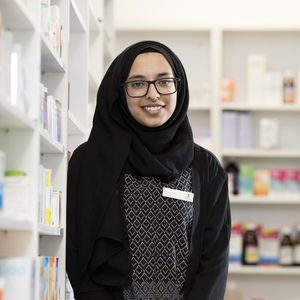
Faatimah Patel
MPharm Pharmacy
Why study Pharmacy at Lincoln?
If you’re interested in science, healthcare, and making a tangible impact on people’s wellbeing, this course gives you a clear, structured path into a respected and rewarding profession.
- Qualify for a career as a registered pharmacist
- Learn through real-world, patient-focused scenarios
- Build practical skills from year one
- Graduate ready for your foundation training year
After the foundation training year, you can register as a pharmacist if you meet all the stipulated criteria set by the General Pharmaceutical Council (GPhC). Once registered, you’ll also be entitled to prescribe.
What sets Lincoln apart:
- ✔ Patient-focused learning – not just theory, but how pharmacy works in real life.
- ✔ Integrated clinical skills training – build confidence communicating with patients early.
- ✔ Strong employability focus – ideal if you want guidance as well as independence.
- ✔ Modern teaching approach – combining science, practice, and decision-making.
- ✔ Nationally recognised course accredited by the GPhC
Lincoln focuses on helping you become job-ready and confident in real healthcare settings.
What you'll learn
This course combines scientific knowledge with professional skills, so you don’t just understand medicines, you know how to use them safely and effectively.
You’ll develop:
- A strong foundation in pharmacology, chemistry, and human biology
- An understanding of how medicines are designed, tested, and prescribed
- Clinical and communication skills needed to work with patients and healthcare teams
- Decision-making skills for safe and effective treatment planning
- Professional knowledge required for pharmacy practice and ethics
Learning is designed to mirror real-life scenarios, helping you connect theory to practice throughout your degree. Assessment methods include formal examinations, presentations, course tests and laboratory reports. In addition, MPharm students will be assessed by observed structured clinical examinations (OSCES) with patients or actors; case-based discussions and care planning; problem-based learning, and a professional portfolio.
Modules
Module Overview
This module aims to introduce students to the profession of pharmacy, its roles and responsibilities and the National Health Service. An integrated approach will be used to teach the pharmaceutical sciences (how patients and medicines work), clinical therapeutics (how medicines are used) and practice skills (how pharmacists work) around the pharmaceutical care of clinical conditions presenting in parenthood/early years, such as childhood allergy. They will be supported by a variety of patient-based learning activities.
Module Overview
An integrated approach will be used to build on the previous module and teach the pharmaceutical sciences, clinical therapeutics and practice skills around the pharmaceutical care of clinical conditions presenting in parenthood/early years, such as childhood infections. They will again be supported by a variety of patient-based learning activities.
Module Overview
An integrated approach will be used to build on the previous modules and teach the pharmaceutical sciences, clinical therapeutics and practice skills around the pharmaceutical care of clinical conditions presenting in young adults, such as Asthma and critical care, integrated with previous conditions studied and building up the complexity of the cases studied. They will be supported by a variety of patient-based learning activities.
Module Overview
You will be able to put your previous learning to use in a real-world setting.
Module Overview
An integrated approach will be used to build on the previous modules and teach the pharmaceutical sciences, clinical therapeutics and practice skills around the pharmaceutical care of clinical conditions presenting in middle age, such as a range of GI disease and cancer, integrated with previous conditions studied and building up the complexity of the cases studied. These will be supported by a variety of patient-based learning activities.
Module Overview
An integrated approach will be used to build on the previous modules and teach the pharmaceutical sciences (how patients and medicines work), clinical therapeutics (how medicines are used) and practice skills (how pharmacists work) around the pharmaceutical care of clinical conditions presenting in middle age, such as diabetes and cardiovascular disease, anxiety and depression integrated with previous conditions studied and building up the complexity of the cases studied. They will be supported by a variety of patient-based learning activities.
Module Overview
This module provides students with the opportunity to develop their own research question and then to address that question using published material. The results of this research will be communicated in the form of a poster presentation, a research paper, and a written commentary each of which will be assessed.
Module Overview
An integrated approach will be used to build on the previous modules and teach the pharmaceutical sciences, clinical therapeutics and practice skills around the pharmaceutical care of clinical conditions presenting in older age, such as COPD and osteoporosis integrated with previous conditions studied and building up the complexity of the cases studied. They will be supported by a variety of patient-based learning activities, and an opportunity to specialise in an individual topic of interest at Master’s level.
Module Overview
An integrated approach will be used to build on the previous modules and teach the pharmaceutical sciences, clinical therapeutics and practice skills around the pharmaceutical care of clinical conditions presenting in older age, such as dementia and Parkinson’s disease, integrated with previous conditions studied and building up the complexity of the cases studied. They will be supported by a variety of patient-based learning activities, and an extended elective placement.
† Some courses may offer optional modules. The availability of optional modules may vary from year to year and will be subject to minimum student numbers being achieved. This means that the availability of specific optional modules cannot be guaranteed. Optional module selection may also be affected by staff availability.
Modules
Module Overview
This module aims to introduce students to the profession of pharmacy, its roles and responsibilities and the National Health Service. An integrated approach will be used to teach the pharmaceutical sciences (how patients and medicines work), clinical therapeutics (how medicines are used) and practice skills (how pharmacists work) around the pharmaceutical care of clinical conditions presenting in parenthood/early years, such as childhood allergy. They will be supported by a variety of patient-based learning activities.
Module Overview
An integrated approach will be used to build on the previous module and teach the pharmaceutical sciences, clinical therapeutics and practice skills around the pharmaceutical care of clinical conditions presenting in parenthood/early years, such as childhood infections. They will again be supported by a variety of patient-based learning activities.
Module Overview
An integrated approach will be used to build on the previous modules and teach the pharmaceutical sciences, clinical therapeutics and practice skills around the pharmaceutical care of clinical conditions presenting in young adults, such as Asthma and critical care, integrated with previous conditions studied and building up the complexity of the cases studied. They will be supported by a variety of patient-based learning activities.
Module Overview
You will be able to put your previous learning to use in a real-world setting.
Module Overview
An integrated approach will be used to build on the previous modules and teach the pharmaceutical sciences, clinical therapeutics and practice skills around the pharmaceutical care of clinical conditions presenting in middle age, such as a range of GI disease and cancer, integrated with previous conditions studied and building up the complexity of the cases studied. These will be supported by a variety of patient-based learning activities.
Module Overview
An integrated approach will be used to build on the previous modules and teach the pharmaceutical sciences (how patients and medicines work), clinical therapeutics (how medicines are used) and practice skills (how pharmacists work) around the pharmaceutical care of clinical conditions presenting in middle age, such as diabetes and cardiovascular disease, anxiety and depression integrated with previous conditions studied and building up the complexity of the cases studied. They will be supported by a variety of patient-based learning activities.
Module Overview
This module provides students with the opportunity to develop their own research question and then to address that question using published material. The results of this research will be communicated in the form of a poster presentation, a research paper, and a written commentary each of which will be assessed.
Module Overview
An integrated approach will be used to build on the previous modules and teach the pharmaceutical sciences, clinical therapeutics and practice skills around the pharmaceutical care of clinical conditions presenting in older age, such as COPD and osteoporosis integrated with previous conditions studied and building up the complexity of the cases studied. They will be supported by a variety of patient-based learning activities, and an opportunity to specialise in an individual topic of interest at Master’s level.
Module Overview
An integrated approach will be used to build on the previous modules and teach the pharmaceutical sciences, clinical therapeutics and practice skills around the pharmaceutical care of clinical conditions presenting in older age, such as dementia and Parkinson’s disease, integrated with previous conditions studied and building up the complexity of the cases studied. They will be supported by a variety of patient-based learning activities, and an extended elective placement.
† Some courses may offer optional modules. The availability of optional modules may vary from year to year and will be subject to minimum student numbers being achieved. This means that the availability of specific optional modules cannot be guaranteed. Optional module selection may also be affected by staff availability.
Placements
Gain hands-on experience in a real workplace and apply your learned skills in a professional setting. MPharm students will have the opportunity to undertake placements within hospital, community, and primary care.
- Develop practical skills and professional confidence
- Build your CV before you graduate
- Explore career options in a real workplace
- Pay a placement year fee
- You’ll need to cover travel and living costs
Support and student experience
Starting a professional degree can feel like a big step, especially in healthcare. Lincoln builds in support at every stage.
You’ll have access to:
- Dedicated academic tutors
- Structured guidance throughout the course
- Skills support for science and study techniques
- Wellbeing and pastoral services
- Careers and employability advice
This is especially important for a Pharmacy degree, where confidence and competence develop together.
Careers and future opportunities
A Pharmacy degree leads directly to a clear and structured career path.
Most graduates go on to:
- Community Pharmacist
- Hospital Pharmacist
- Clinical Pharmacist (working alongside doctors and nurses)
- Primary Care Pharmacist (GP surgeries and health centres)
Other opportunities include:
- Pharmaceutical industry roles (drug development, regulation)
- Research and clinical trials
- Public health and policy
After graduating, you’ll complete a foundation training year and pass the registration assessment to become a qualified pharmacist.
Why this matters:
- Pharmacy offers strong job stability and demand across the UK
- Clear progression routes into specialist and senior roles
- Opportunities to work in both patient-facing and scientific careers
Entry Requirements 2026-27
United Kingdom
128 UCAS Tariff points
This must be achieved from a minimum of 3 A Levels to include a minimum of 40 points in Biology or Chemistry plus a minimum of 40 points in a second Science subject. Chemistry, Biology, Physics, Applied Science, Maths or Further Maths are accepted. General Studies, Critical Thinking and Extended Project qualifications are not accepted.
A Levels: ABB, to include a minimum grade B in Biology or Chemistry plus a minimum grade B in a second Science subject. Chemistry, Biology, Physics, Applied Science, Maths or Further Maths are accepted. General Studies, Critical Thinking and Extended Project qualifications are not accepted.
International Baccalaureate: 32 points overall to include Higher Level grade 5 in Biology or Chemistry and Higher Level grade 5 in a second Science subject. (Biology, Chemistry, Maths, Further Maths, Physics, are accepted).
GCSEs: Minimum of five GCSEs to include a grade 6 in Maths, a grade 4 in English and Science and two further GCSE's grade at 4 or above. Equivalent Level 2 qualifications may also be considered.
If you would like further information about entry requirements, or would like to discuss whether the qualifications you are currently studying are acceptable, please contact the Admissions team on 01522 886097, or email admissions@lincoln.ac.uk.
Additional requirements:
- Successful performance at an interview.
- Satisfactory completion of an Enhanced Disclosure from the Disclosure and Barring Service (DBS).
When you choose Pharmacy in your UCAS application, you will be asked an additional question regarding criminal convictions. Here you must declare all spent and unspent criminal convictions including (but not limited to) cautions, reprimands, final warnings, bind over orders or similar and details of any minor offences, fixed penalty notices, penalty notices for disorder, ASBOs or VOOs.
International
Non UK Qualifications:
If you have studied outside of the UK, and are unsure whether your qualification meets the above requirements, please visit our country pages for information on equivalent qualifications.
https://www.lincoln.ac.uk/studywithus/internationalstudents/entryrequirementsandyourcountry/
In addition to meeting the academic requirements, overseas students will also be required to demonstrate English language proficiency equivalent to IELTS 6.5 overall, with a minimum of 6.0 in each element. Please visit our English language requirements page for a full list of the English qualifications we accept.
https://www.lincoln.ac.uk/studywithus/internationalstudents/englishlanguagerequirements/
If you do not meet the above IELTS requirements, you may be able to take part in one of our Pre-sessional English and Academic Study Skills courses.
The University of Lincoln offer a dedicated support service for overseas students. If you have any questions about your qualifications, or would like assistance in submitting your application, please contact us at
https://www.lincoln.ac.uk/studywithus/internationalstudents/contactus/
For applicants who do not meet our standard entry requirements, our Science Foundation Year can provide an alternative route of entry onto our full degree programmes:
Entry Requirements 2027-28
United Kingdom
128 UCAS Tariff points from a minimum of 3 A Levels to include 40 points in Biology or Chemistry plus 40 points in a second Science subject. Chemistry, Biology, Physics, Applied Science, Maths or Further Maths are accepted. General Studies, Critical Thinking and Extended Project qualifications are not accepted.
Contextual offers are not considered for this course.
A Levels: ABB, to include a minimum grade B in Biology or Chemistry plus a minimum grade B in a second Science subject. Chemistry, Biology, Physics, Applied Science, Maths or Further Maths are accepted. General Studies, Critical Thinking and Extended Project qualifications are not accepted.
International Baccalaureate: 32 points overall to include Higher Level grade 5 in Biology or Chemistry and Higher Level grade 5 in a second Science subject. (Biology, Chemistry, Maths, Further Maths, Physics, are accepted).
GCSEs: Minimum of five GCSEs to include a grade 6 in Maths, a grade 4 in English and Science and two further GCSE's grade at 4 or above. Equivalent Level 2 qualifications may also be considered.
If you would like further information about entry requirements, or would like to discuss whether the qualifications you are currently studying are acceptable, please contact the Admissions team on 01522 886097, or email admissions@lincoln.ac.uk.
Additional requirements:
- Successful performance at an interview.
- Satisfactory completion of an Enhanced Disclosure from the Disclosure and Barring Service (DBS).
When you choose Pharmacy in your UCAS application, you will be asked an additional question regarding criminal convictions. Here you must declare all spent and unspent criminal convictions including (but not limited to) cautions, reprimands, final warnings, bind over orders or similar and details of any minor offences, fixed penalty notices, penalty notices for disorder, ASBOs or VOOs.
International
Non UK Qualifications:
If you have studied outside of the UK, and are unsure whether your qualification meets the above requirements, please visit our country pages for information on equivalent qualifications.
https://www.lincoln.ac.uk/studywithus/internationalstudents/entryrequirementsandyourcountry/
In addition to meeting the academic requirements, overseas students will also be required to demonstrate English language proficiency equivalent to IELTS 6.5 overall, with a minimum of 6.0 in each element. Please visit our English language requirements page for a full list of the English qualifications we accept.
https://www.lincoln.ac.uk/studywithus/internationalstudents/englishlanguagerequirements/
If you do not meet the above IELTS requirements, you may be able to take part in one of our Pre-sessional English and Academic Study Skills courses.
The University of Lincoln offer a dedicated support service for overseas students. If you have any questions about your qualifications, or would like assistance in submitting your application, please contact us at
https://www.lincoln.ac.uk/studywithus/internationalstudents/contactus/
For applicants who do not meet our standard entry requirements, our Science Foundation Year can provide an alternative route of entry onto our full degree programmes:
Interviews
All MPharm Pharmacy applicants will be required to attend an interview. This is a condition for making applicants an offer. Applicants will receive an invitation to attend an interview via UCAS Track. Alternative arrangements will be considered for applicants who cannot attend.
Is this course right for you?
This course could be a great fit if you:
- Enjoy science, especially chemistry and biology
- Want a clear career path in healthcare
- Like the idea of working directly with patients
- Are looking for a degree with strong job prospects
- Want a balance of academic learning and practical skills
If you’re still deciding between healthcare careers, Pharmacy offers a unique mix of science, patient care, and professional stability.
Fees and Funding
University Study is a major investment, so it’s important to understand the costs and support available. A full breakdown of the fees associated with this programme can be found below. Eligible students may be able to access scholarships and bursaries to help with study costs.
Fees and Funding
University Study is a major investment, so it’s important to understand the costs and support available. A full breakdown of the fees associated with this programme can be found below. Eligible students may be able to access scholarships and bursaries to help with study costs.