Skip to content

Clearing offers from 48 UCAS tariff points. Subject-specific requirements still apply. See the entry requirements section for details.

Understand performance. Improve wellbeing. Build a career in sport, health, or psychology.

Psychology (Sport and Exercise Psychology) explores how the mind influences performance, motivation, and wellbeing.

At Lincoln, you'll learn how psychological principles are used to:
•Improve athletic performance
•Support mental health and wellbeing
•Encourage behaviour change in health and fitness
•Understand how people think, feel, and act in high-pressure environments

This course combines core psychology with specialist sport and exercise topics, giving you a broad, flexible degree that keeps your career options open. A degree in Psychology (Sport and Exercise Psychology) can lead to careers in sport, healthcare, education, or beyond. You'll gain hands-on experience, practical skills, and career-focused knowledge, so you graduate ready for real-world roles or further professional training.

My undergraduate psychology degree gave me a solid base in psychological theories and research, whilst allowing me the chance to develop my interests in specific areas, such as sport and mental health.

Why study Psychology (Sport and Exercise Psychology) at Lincoln?

Dual focus leads to more career options Study accredited (by the British Psychological Society) psychology alongside applied sport and exercise topics. 

Career-ready from day one Build skills in research, communication, data analysis, and behaviour change. 

Real-world application Learn how psychology is used in sport performance, coaching, health improvement, and rehabilitation. 

Flexible progression Keep pathways open to careers in psychology, sport science, health, teaching, and business. 

Supportive learning environment Smaller, more personal teaching compared to large institutions. 

What you'll learn

This course is designed to help you understand people and apply that knowledge in real situations.

You’ll develop:

Core psychology knowledge

  • How the brain works and influences behaviour
  • Mental health, emotion, and cognition
  • Social behaviour and group dynamics

Sport and exercise psychology skills

  • Motivation and performance under pressure
  • Coaching psychology and athlete development
  • Behaviour change in health and fitness
  • Psychological approaches to injury and recovery

Practical and career-focused skills

  • Research design and data analysis
  • Communication and presentation
  • Critical thinking and problem-solving

What makes this valuable?
You won’t just learn theories, you’ll learn how to apply them in sport, health, and performance settings, which is exactly what employers look for.

Modules

Module Overview

This module aims to introduce students to a wide range of topics outlining the structure and functions of the brain and nervous system, and the relationship between these brain structures and the behaviours, both covert and overt, resulting from them. The module serves as the foundation for the second year core module in cognition, and a number of elective modules expand on ideas introduced here.

Module Overview

This module builds on the introduction to research in psychology and sport science in Semester A by exploring in greater depth how to design appropriate studies and communicate research findings effectively. Using a combination of lectures and workshops, students will learn how to plan and conduct research using both quantitative and qualitative methods, analyse quantitative and qualitative data, and present findings in a research report. Typically, real-world examples and practical activities will be used to help develop students’ confidence as emerging independent researchers. This module will lay the foundations for more advanced research tuition in year 2.

Transferrable Skills Building on the previous research skills module, this module will further develop the previously identified set of Skills for Life: global mindset, active learning, critical thinking, complex problem solving, digital & data literacy, leadership & influence, persuasion & negotiation and equality & inclusion. Students will continue to incorporate consideration of researcher and participant sample bias (i.e. WEIRD & non-WEIRD participants) as well as equality & inclusion in research practices. Students will also continue to work in groups require critical thinking and active learning to solve complex problems. Digital and data literacy skills will continue to be strengthened throughout.

Module Overview

This module provides an introduction to three major areas of psychological theory and research, Developmental, Social and Individual psychology. The topics are covered in Semesters A and B respectively and grouped thematically. Content across all topics is embedded in the context of major, relevant general, developmental, social and individual differences theories.

Module Overview

An appreciation of research methods is critical for understanding empirical disciplines like psychology and sport science. This module introduces students to some of the basic concepts underlying qualitative and quantitative research methods. It focuses on foundational understanding of knowledge production including epistemology, ontology, ethics, design sampling, analysis tools and writing skills. This module provides the foundations for research in psychology and sport science that students will be able to build on during their degree and beyond.

The module will address the following Skills for Life: global mindset, active learning, critical thinking, complex problem solving, digital & data literacy, leadership & influence, persuasion & negotiation and equality & inclusion. More specifically, on this module, students will develop their global mindset through considering bias and non-WEIRD (Western, Educated, Industrialized, Rich, Democratic) participant groups in research. Students will be active learners, required to think critically and solve complex problems in teams applying leadership, persuasion & negotiation skills while centring equality and inclusion. Digital and data literacy skills will be strengthened throughout.

Module Overview

This module introduces students to key concepts, theories and applications of psychology in sport, exercise and physical activity settings. Students will develop understanding of how psychological factors influence participation and performance, and how sport and physical activity can impact psychological wellbeing and other outcomes. Students will typically develop skills in active learning, open-mindedness, curiosity, and emotional intelligence.

Module Overview

The module will introduce students to science-backed tools and habits that they can use to improve their own skills, social awareness and wellbeing, and to enhance their own lives as psychological literate citizens. Students will typically develop skills in scientific and psychological literacy, critical thinking, self-reflection, written and oral communication and teamwork.

Module Overview

This module aims to build and develop quantitative and qualitative research skills that were acquired at Level 4. These will include research design, analysis and data handling. In lectures, students will be introduced to a range of statistical and non-statistical topics relating to applied research. Parallel workshops will provide hands-on training in qualitative and quantitative study design and analysis. Working in small groups under academic supervision, students will complete a research project.

Module Overview

The module extends the investigations of cognition that began in the first year. Areas critical to our understanding of cognition are considered in more depth, with consideration of both classic and current research into cognitive processes from both a cognitive and cognitive neuroscience approach.

Module Overview

This module aims to examine the concepts, theories, research methods and influencing factors in child development relevant to the period from birth to pre-adolescence.

Module Overview

This module will facilitate a deeper level of knowledge, understanding and critical awareness in key areas of health and exercise psychology. Through the evaluation and critical appraisal of behaviour change approaches/models, theories, and research evidence, students on this module will consider how knowledge is developed and applied in the context of physical activity/exercise promotion and maintenance. Students will be required to challenge existing knowledge and best practice across developing and topical lines of research, which will foster skills such as critical thinking, curiosity, and open-mindedness.

Module Overview

The module aims to provide an introduction into psychological assessments using psychometrics, including questionnaires and scales. Based on the established theoretical and research context, this module will consider a range of assessment tools used in psychology to assess an individual’s behaviour or behavioural disposition, and provide an introduction into psychometric test development. The modules also aims to provide students with the opportunity to administer, score, and interpret psychological tests.

Module Overview

This module aims to showcase how research is applied in practice, in policy and in the context of the Sustainable Development Goals (SDG) and social responsibility. In lectures, students will be introduced to examples of how research is applied in the workplace, how research is used to shape policy, and how research relates to the SDGs and social responsibility. In parallel, a series of workshops will teach students to apply this knowledge. This module develops the following Skills for Life: global mindset, leadership & influence, active learning, critical thinking, solving complex problems and equality & inclusion. Specifically, on this module, students will develop their global mindset and leadership & influence through considering how research is applied in a global context, including contributing to the SDGs and writing for a general audience. By developing a dissertation proposal, students will be active learners, required to think critically and solve complex problems while centring equality and inclusion.

Module Overview

This module seeks to explore some of the central issues of social psychology, including how people deal with social information, such as the causes of behaviour and social categories, and how groups function and interact.

Module Overview

This module will facilitate a deeper level of knowledge, understanding and critical awareness in key areas of sport and performance psychology. Through the evaluation and critical appraisal of core concepts, theories, and research evidence, students on this module will consider how knowledge is developed and applied to aid performance and psychological outcomes in sporting contexts. Students will be required to challenge existing knowledge and best practice across developing and topical lines of research, which will foster skills such as critical thinking, curiosity, and open-mindedness.

Module Overview

This optional, year-long module enables students to spend a year studying abroad at one of the University’s approved partner institutions. Eligible students must have completed their second year of study to a satisfactory standard and successfully completed the application process for the year abroad. During the year spent abroad, students share classes with local students and study on a suite of locally-delivered taught modules which have been approved in advance by the University. Upon their return, as part of the assessment for this module, students are required to critically reflect upon their experience of living and studying in a different cultural environment and the skills acquired.

Module Overview

This module aims to create a valuable opportunity for students to gain important insights and improve their skills and prospects relevant to employment or further study (i.e. within psychology, sports science, therapy, rehabilitation or related subject areas) by undertaking relevant work experience.

Module Overview

This module will deepen students’ understanding of psychological concepts, theories and models in sport and exercise settings. Students will critically engage with contemporary research and apply theoretical knowledge to real-world scenarios, including case studies and applied interventions. Students will have the opportunity to assess an athlete’s psychological profile and explain how psychological interventions could be designed and implemented. Students will typically develop skills in critical thinking, complex problem-solving, equality and inclusion, emotional intelligence, and intercultural awareness.

Module Overview

This module aims to draw on aspects of cognitive and clinical neuropsychology to examine the consequences of brain dysfunction. A particular focus will be upon the interdependence of clinical and experimental neuropsychology, and it is within this context that the role of neuropsychology in research, diagnosis and patient management can be explored.

Module Overview

This module provides an opportunity for an in-depth study of a particular topic relevant to the field of their particular degree and to demonstrate original and critical thought. The Dissertation module tests a student’s ability to identify an appropriate research question and to design a method that allows data collection and analysis to be conducted in order to answer the proposed research question. Students will typically develop skills in scientific literacy, critical thinking, data analysis, and written and oral communication. Skills for Life will be gained in Complex Problem Solving, Critical Thinking, Curiosity & Digital & Data Literacy.

All Dissertation projects must be derived from and/or embedded within a clear theoretical framework. Students have to demonstrate their knowledge of research skills in order to analyse the data gathered and their theoretical knowledge in interpreting the results of their study in relation to the background literature. This can be done through the use of quantitative methods, qualitative methods, or a combination. The module is assessed through the presentation of their research via a poster presentation and the production of a written thesis. The role of the supervisor is to guide them through these processes and the students will be supported through a range of masterclasses covering topics aligned to the development of the students' research.

Module Overview

The module will be structured around critical understanding of the accuracy of science communication. Critically, it will also include interactive components, dedicated to developing clear and accurate communication skills, and discriminating between accurate and inaccurate science communication. Students will typically develop skills in scientific literacy, scientific communication, critical thinking, and written and oral communication.

Module Overview

In this module you can explore addictive behaviours, substance abuse, and dependence in society and consider their prevalence and treatment strategies. Whether looking at individual disorders or commonalities across all disorders, you can understand the risk factors for addiction, examine the limitations of biological explanations for addiction, and evaluate the development of the field of psychological study of addictions.

Module Overview

This module specialises in presenting the psychological scientific foundations of 'intervention science' in an organisational context. It covers the process of developing interventions to investigate and address key organisational problems.

Module Overview

This module provides a critical evaluation of the way the Organisational Psychology literature approaches common workplace issues.

Module Overview

This module aims to examine the developmental disability of Autism (and Autistic Spectrum Disorders). It aims to cover a range of approaches to understanding Autism, from diagnosis and etiology.

Module Overview

This module is designed to develop understanding of body image and eating disorders. This module will typically cover their aetiology, diagnosis, assessment, and treatment in diverse populations including children, men, BAME (Black, Asian, Minority Ethnic)/POC (People of Colour) and LGBTQIA+. The module typically aims to give students an appreciation of the complicated and multi-determined field of body image and eating disorders; as well as the limitations of methodology both for clinical assessment and research paradigms. This module typically further aims to examine attitudes to eating, body shapes and sizes, their driving factors, and challenge the students to analyse and synthesise via exercises in seminars.

Module Overview

The module provides students with an introduction to the field of community psychology. This area of psychology is concerned with the relationship between the individual, their community and society. Based on values that contextualise experiences by taking an ecological over individual analysis, it aims to understand and enhance quality of life for marginalised, disempowered and invisible individuals. Community psychology is not wedded to any orthodoxy of methods but adopts a pragmatic, pluralistic and reflexive stance.

Module Overview

This module is designed to introduce you to counselling theories and aims to help to develop introductory communication and counselling skills. A Person-Centred approach to counselling skills will be used and an important aspect of this module will be providing you with the opportunity of development of learning through self-reflection.

Module Overview

This module aims to emphasise the importance of a developmental framework for understanding how children come to exhibit adaptive and maladaptive behaviour. The module will seek to address the changing nature of problems, influences and risk factors over the course of development.

Module Overview

The module aims to introduce some of the key areas in Forensic Psychology that occur during the pre-conviction stage of a criminal investigation. Specifically, the module will focus on the police investigation and courtroom stage of the criminal process. It will explore a variety of established theoretical work and research within these domains and consider how this knowledge can be used to inform several key areas of the criminal investigation. The module will highlight the applied importance of Psychology to significant issues in the real-world.

Module Overview

This module is designed to give students the opportunity to develop a critical awareness and understanding of psychological issues typically related to the assessment, perception, communication, management and governing of risk as it affects professional practices in such areas as public health, politics, the environment, science and technology, corporate communication, and clinical/forensic psychology.

Module Overview

This module examines the potential benefits of sleep, focusing in particular on two areas. The role of sleep in memory and cognition will be explored in depth, followed by a wider examination of other benefits of sleep for well-being, which may include effects on mood, physical health and aspects of behaviour. Students will be introduced to the way in which sleep can benefit cognition and well-being and the experimental paradigms used to demonstrate this. The aims of the module are to consider in depth the potential role of sleep in both cognition and well-being, and develop the skills and knowledge that will enable the critique of the different approaches taken in this field leading to the ability to interpret and integrate current research findings and design original further research studies.

Module Overview

This module is designed to introduce the background, theories and techniques of Social cognitive neuroscience. SCN seeks to understand socioemotional phenomena in terms of interactions between the social (socioemotional cues, contexts, experiences, and behaviors), cognitive (information processing mechanisms), and neural (brain bases) levels of analysis.

Module Overview

Work experience is invaluable for undergraduate Psychology students as it has the potential to bridge the gap between academic learning and real-world applications. This module will provide you with the opportunity to enhance your practical, graduate level employability skills and insights that are not typically developed in traditional classroom settings.


† Some courses may offer optional modules. The availability of optional modules may vary from year to year and will be subject to minimum student numbers being achieved. This means that the availability of specific optional modules cannot be guaranteed. Optional module selection may also be affected by staff availability.

Support and student experience

Starting university is a big step and support makes all the difference.

At Lincoln, you’ll have access to:

  • Academic support
    Help with study skills, research, and assessments
  • Personal tutors
    Guidance throughout your degree
  • Wellbeing services
    Mental health and pastoral support when you need it
  • Careers support
    CV help, interview preparation, and career planning

What this means for you:
You won’t be left to figure things out on your own. There’s a clear support system in place from day one.

Since graduating I have worked in clinical psychology as an assistant psychologist, during which I utilised the research, analysis and report writing skills learned in my time at Lincoln.

International Study

Study overseas at a partner university and experience a new culture.

  • Build confidence, independence, and intercultural experience
  • You’ll pay the relevant study abroad fee to the University of Lincoln, with no tuition fees paid to the host university
  • You’ll need to cover travel and living costs
  • Funding support may be available

Work Experience 

Gain hands-on experience in a real workplace and apply your learned skills in a professional setting.

  • Develop practical skills and professional confidence
  • Build your CV before you graduate
  • Explore career options in a real workplace
  • Pay a placement year fee
  • You’ll need to cover travel and living costs

Careers and future opportunities

A degree in Psychology (Sport and Exercise Psychology) opens more doors than most students expect.

Common career paths

Graduates go into roles such as:

  • Sport and exercise psychologist (with further training)
  • Health and wellbeing advisor
  • Coach or performance analyst
  • Fitness and behaviour change specialist
  • Teaching and education
  • HR, marketing, or business roles

Where you could work

  • Professional and amateur sports organisations
  • NHS and healthcare services
  • Schools and education settings
  • Fitness and wellbeing industries
  • Corporate organisations

Further study pathways

This degree can lead to:

  • Postgraduate psychology training (e.g. clinical, counselling, sport psychology)
  • Teacher training
  • Specialist sport science or health programmes

Psychology graduates are valued for their transferable skills, meaning you’re not limited to one career path. You’ll graduate with options, not pressure.

BPS Accreditation

The course is accredited by the British Psychological Society (BPS) as conferring eligibility for the Graduate Basis for Chartered membership (GBC) the first step towards becoming a chartered psychologist. The BPS is the main professional body representing psychology and psychologists in the UK.

BPS Logo

Is this course right for you?

This course could be a great fit if you:

  • Are interested in psychology but want a practical, applied focus
  • Enjoy understanding how people think, behave, and perform
  • Are considering careers in sport, health, psychology, or teaching
  • Want a degree that keeps your options open

If you’re unsure about your exact career yet, that’s okay. This course is designed to give you direction, not limit you.

Entry Requirements 2026-27

United Kingdom

104 to 120 UCAS Tariff points.

This must be achieved from a minimum of 2 A Levels or equivalent Level 3 qualifications. For example:

A Level: BCC to BBB

BTEC Extended Diploma: Distinction Distinction Merit

T Level: Merit Overall

Access to Higher Education Diploma: 104 to 120 UCAS points to be achieved from 45 Level 3 credits.

International Baccalaureate: 28 points overall.

GCSE's: Minimum of three at grade 4 or above, which must include English and Maths . Equivalent Level 2 qualifications may be considered.

The University accepts a wide range of qualifications as the basis for entry and do accept a combination of qualifications which may include A Levels, BTECs, Extended Project Qualification (EPQ).

We may also consider applicants with extensive and relevant work experience and will give special individual consideration to those who do not meet the standard entry qualifications.

International

Non UK Qualifications:

If you have studied outside of the UK, and are unsure whether your qualification meets the above requirements, please visit our country pages

https://www.lincoln.ac.uk/studywithus/internationalstudents/entryrequirementsandyourcountry/ for information on equivalent qualifications.

EU and Overseas students will be required to demonstrate English language proficiency equivalent to IELTS 6.0 overall, with a minimum of 5.5 in each element. For information regarding other English language qualifications we accept, please visit the English Requirements page

https://www.lincoln.ac.uk/studywithus/internationalstudents/englishlanguagerequirementsandsupport/englishlanguagerequirements/

If you do not meet the above IELTS requirements, you may be able to take part in one of our Pre-sessional English and Academic Study Skills courses.

https://www.lincoln.ac.uk/studywithus/internationalstudents/englishlanguagerequirementsandsupport/pre-sessionalenglishandacademicstudyskills/

If you would like further information about entry requirements, or would like to discuss whether the qualifications you are currently studying are acceptable, please contact the Admissions team on 01522 886097, or email admissions@lincoln.ac.uk

Contextual Offers

At Lincoln, we recognise that not everybody has had the same advice and support to help them get to higher education. Contextual offers are one of the ways we remove the barriers to higher education, ensuring that we have fair access for all students regardless of background and personal experiences. For more information, including eligibility criteria, visit our Offer Guide pages. If you are applying to a course that has any subject specific requirements, these will still need to be achieved as part of the standard entry criteria.
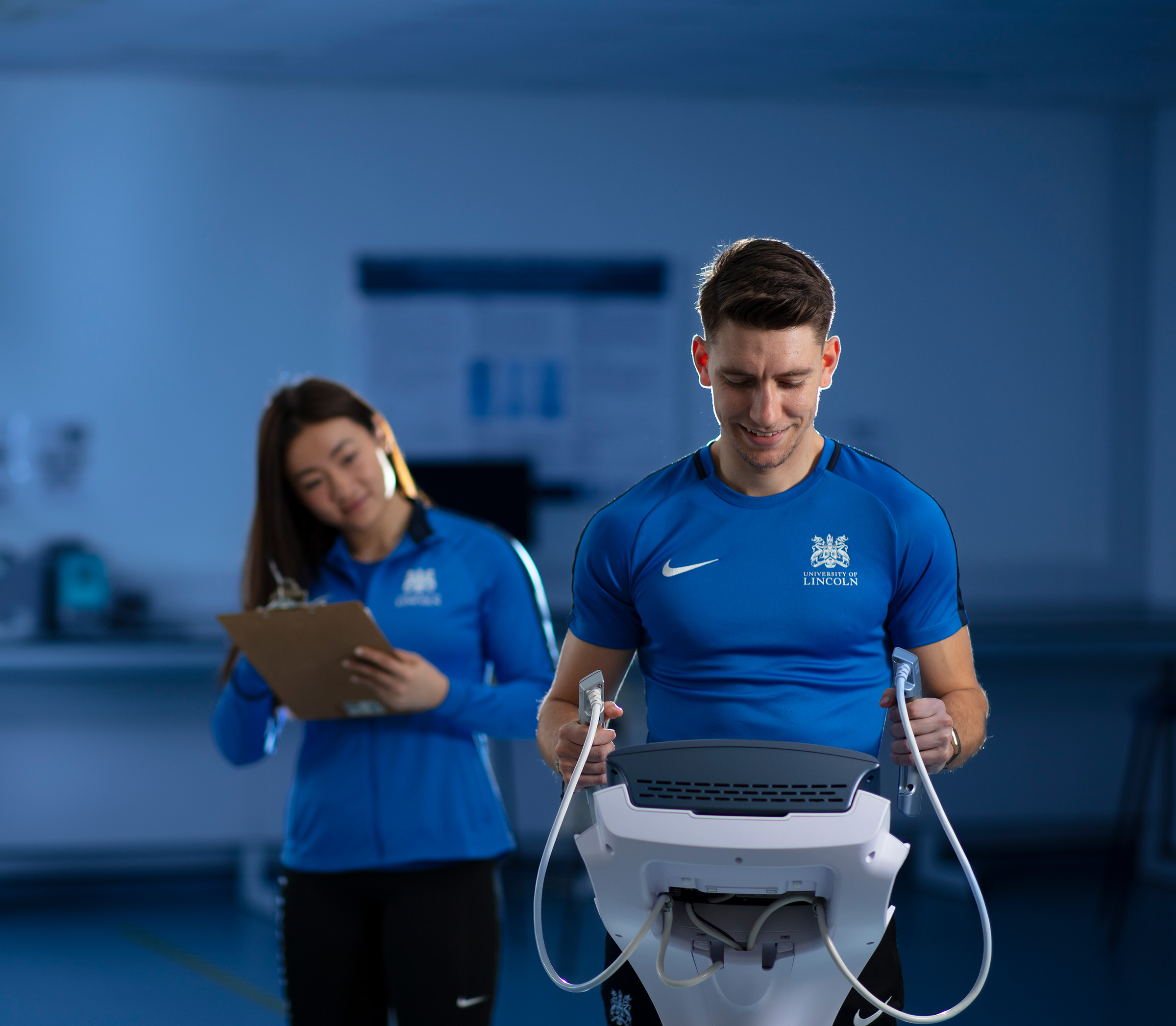
A student working with a test subject at a machine

Psychology Foundation Year

The Psychology Foundation Year at Lincoln give you the space to build confidence, strengthen your academic skills, and develop the subject knowledge you need to succeed at university. They are designed for students with potential who may not yet meet standard BSc entry requirements.

Fees and Funding

University Study is a major investment, so it’s important to understand the costs and support available. A full breakdown of the fees associated with this programme can be found below. Eligible students may be able to access scholarships and bursaries to help with study costs.

Course Fees

Find out More by Visiting Us

The best way to find out what it is really like to live and learn at Lincoln is to visit us in person. We offer a range of opportunities across the year to help you to get a real feel for what it might be like to study here.

Three students walking together on campus in the sunshine

What You Need to Know

We want you to have all the information you need to make an informed decision on where and what you want to study. In addition to the information provided on this course page, our What You Need to Know page offers explanations on key topics including programme validation/revalidation, additional costs, and contact hours.

The University intends to provide its courses as outlined in these pages, although the University may make changes in accordance with the Student Admissions Terms and Conditions.